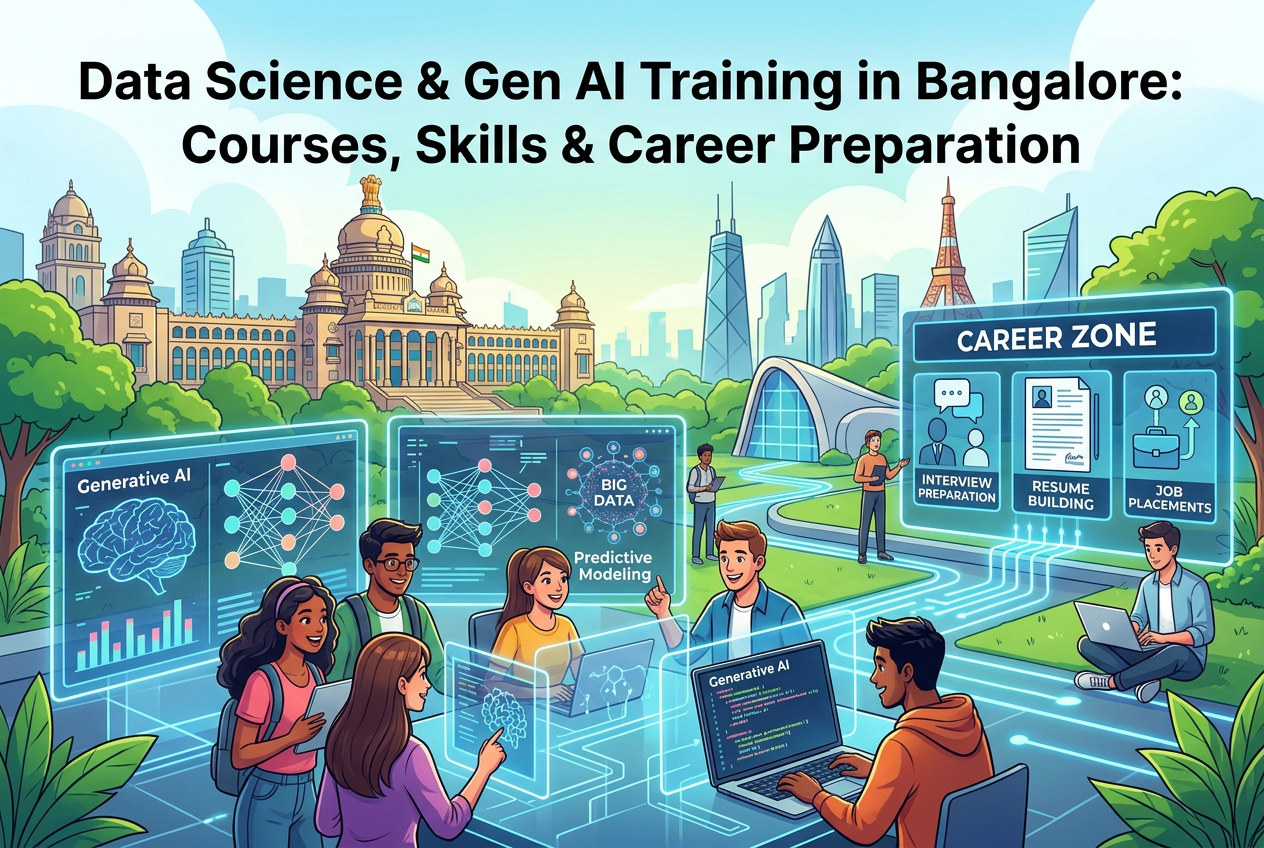
Bangalore has a diverse technology ecosystem that includes software companies, startups, consulting firms, research teams and businesses building AI-enabled products. As organisations explore data-driven decision-making and automation, skills in data analysis, machine learning and Generative AI are becoming relevant across different job functions.
For learners considering Data Science and Gen AI training in Bangalore, choosing the right course means understanding the skills involved, the time needed to practise them and the difference between completing training and becoming job-ready.
What Does Data Science Training Cover?
Data science combines programming, statistics, data preparation and analytical reasoning. A beginner typically starts by learning how to work with data before progressing to predictive modelling and more advanced techniques.
A structured curriculum may include:
- Python programming for data handling and analysis.
- SQL for retrieving information from databases.
- Data cleaning and exploratory data analysis.
- Statistics and probability fundamentals.
- Data visualisation and dashboard development.
- Machine learning concepts and model evaluation.
- Projects based on practical business questions.
The order of learning matters. Students need sufficient practice with programming and data analysis before attempting complex modelling tasks.
What Is Generative AI Training?
Generative AI focuses on systems that can produce content such as text, code, images and summaries. Large language models and prompt engineering are common introductory topics.
Learners may explore how to write clearer prompts, evaluate generated responses and use AI tools in workflows such as document summarisation or programming assistance.
Generative AI should not be treated as a substitute for analytical foundations. AI-generated code and explanations can contain errors, so learners need enough technical understanding to check the results.
Skills to Develop for Data-Related Roles
Python and SQL
Python supports data preparation, analysis and machine learning. SQL helps retrieve and organise data from relational databases. Together, these skills provide a useful foundation for many analytical tasks.
Statistics and analytical thinking
Candidates should understand distributions, averages, variability, probability and the limitations of observed relationships. These concepts help them interpret data rather than simply produce outputs from a tool.
Visualisation and communication
Analysts often need to explain their findings to people who do not work with data every day. Clear charts, concise reports and well-supported conclusions are therefore valuable skills.
Machine learning fundamentals
Learners interested in data science roles can progress to regression, classification, clustering and model evaluation. They should understand how models are tested and why accuracy alone may not fully describe performance.
Responsible use of AI
Generative AI tools can assist with coding, research and content development, but users must consider privacy, reliability, bias and security. The ability to verify AI-generated information is an important practical skill.
Why Projects Matter
Projects help learners apply technical concepts to realistic problems. Examples include analysing retail sales, investigating customer churn, building a dashboard or comparing the performance of basic predictive models.
A good project should explain the business question, data source, cleaning steps, method, findings and limitations. Candidates should be able to discuss their reasoning and explain how they would improve the analysis.
A portfolio can support interviews, but it does not guarantee selection. Employers may also evaluate communication, problem-solving, technical depth and the ability to work with others.
How to Compare Courses in Bangalore
Before selecting a course, compare the syllabus, training format, instructor access, project feedback, fees and schedule. Ask whether learners receive support when they encounter difficulties and whether the course includes opportunities to explain their work.
It is also important to understand career support. Resume guidance, mock interviews and job-search preparation may be useful, but placement assistance is not a promise of employment. Hiring depends on skills, interview performance, employer requirements and vacancies.
Prospective learners considering NUCOT data science program should review the current course details directly, confirm the applicable terms and assess whether the learning path matches their background and goals.
Building a Realistic Learning Plan
Beginners can start with Python and SQL, then move to data cleaning, statistics and visualisation. Once comfortable with those foundations, they can study machine learning and explore relevant Generative AI applications.
The pace will vary according to prior experience and practice time. Consistent exercises, feedback and project work are generally more useful than trying to learn every tool at once.
Conclusion
Data Science and AI training in Bangalore can help learners develop technical knowledge relevant to data-driven work, but choosing a program requires careful evaluation. Look for a logical curriculum, practical projects, feedback and transparent course terms.
A strong learning plan combines technical foundations with communication and problem-solving. Learners who practise consistently and develop realistic expectations will be better prepared to demonstrate their abilities when pursuing relevant opportunities.